
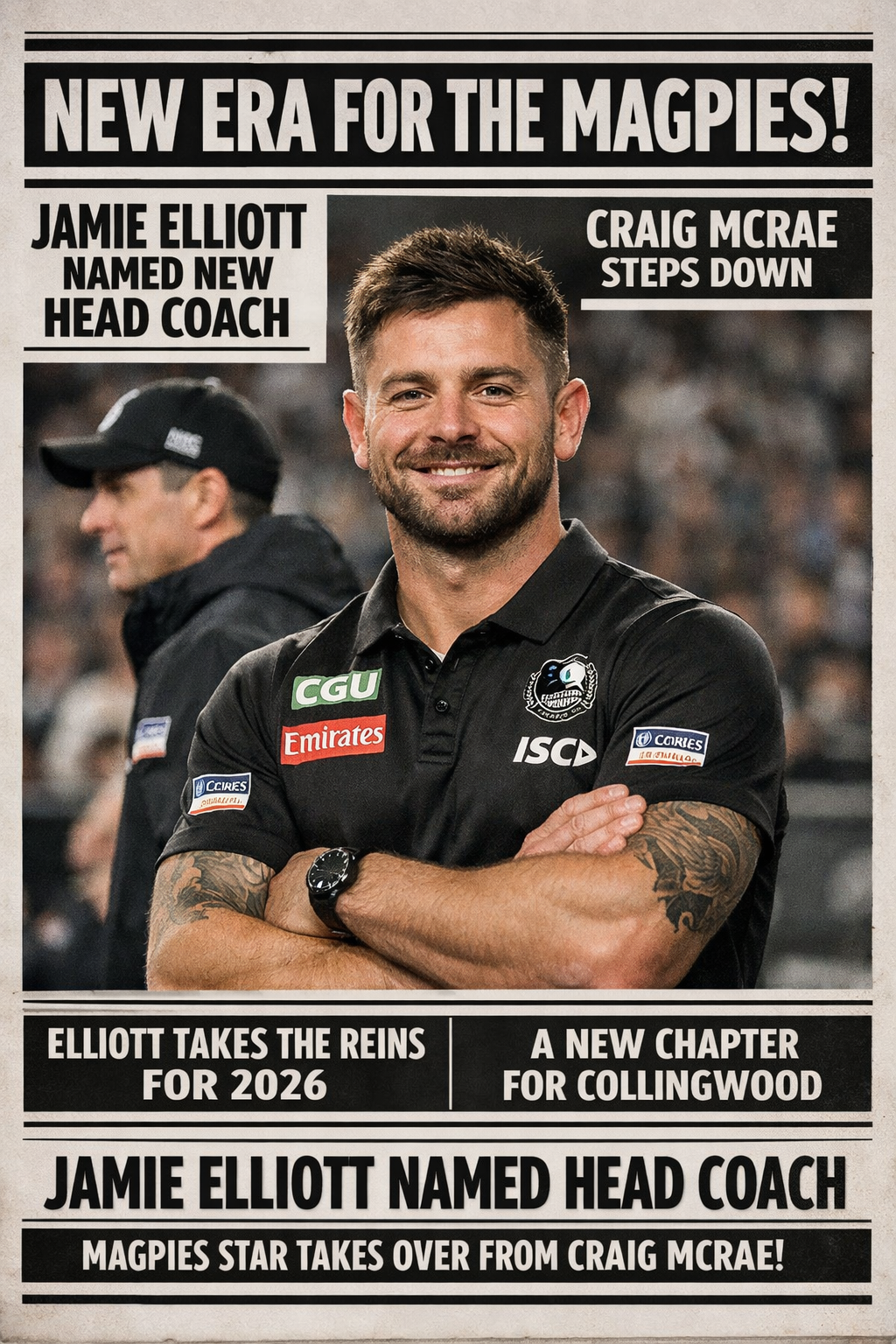
Collingwood Football Club has ushered in what it is calling a bold new era, announcing club legend Jamie Elliott as its head coach for the 2026 AFL season, succeeding premiership-winning coach Craig McRae. The appointment marks one of the most intriguing leadership transitions in the modern history of the Magpies, blending emotional connection, cultural continuity, and a fresh football philosophy aimed at sustained success.
Elliott, long admired for his resilience, football intelligence, and match-winning ability, steps into the senior coaching role following McRae’s influential tenure. Under McRae, Collingwood redefined its identity—embracing daring ball movement, mental freedom, and an unshakeable belief system that carried the club to the summit of the AFL. His departure signals the end of a transformative chapter, but the club believes Elliott is uniquely placed to build on those foundations rather than reset them.
Speaking at the announcement, Collingwood president Jeff Browne described Elliott’s appointment as “a natural evolution rather than a radical change.” Browne highlighted Elliott’s deep understanding of the club’s values and playing group, noting that his leadership qualities had been evident well beyond his on-field heroics. “Jamie has lived the Collingwood experience—through adversity, triumph, and expectation. He understands what it means to wear the black and white,” Browne said.
Elliott’s journey to the senior coaching role has been deliberately shaped. After transitioning from his playing career, he immersed himself in development coaching, match analysis, and leadership programs, working closely with McRae and the football department. Insiders say Elliott was heavily involved in mentoring younger players, particularly forwards, and played a key role in reinforcing the club’s standards around professionalism and accountability.
In his first address as head coach, Elliott struck a calm but ambitious tone. “This club is built on belief, courage, and connection,” he said. “Craig McRae set an incredible standard, and my goal is to honour that while continuing to evolve how we play and prepare. The competition never stands still, and neither can we.”
Elliott emphasized that Collingwood’s attacking instincts would remain intact, but hinted at tactical refinements, particularly around defensive transition and midfield versatility. “We want to be brave with the ball, but also ruthless without it,” he explained. “The next step is turning moments of momentum into sustained dominance.”
The reaction from players has reportedly been overwhelmingly positive. Several senior figures within the squad have spoken privately about Elliott’s relatability and clarity as strengths that resonate strongly with the playing group. Younger players, in particular, are said to appreciate his firsthand understanding of pressure, injury setbacks, and the mental demands of elite football.
From a supporter perspective, the appointment has sparked excitement and curiosity in equal measure. Elliott is a fan favourite—renowned for clutch goals and big-game performances—and his elevation to head coach carries emotional weight. For many supporters, it represents continuity of spirit while opening the door to a new tactical voice.
The challenge ahead is substantial. Succeeding a coach as influential as McRae comes with expectation, scrutiny, and little margin for error. Elliott will be tasked with managing a list still in premiership contention while guiding the next generation of Magpies into leadership roles.
Yet within the club, confidence is high. Collingwood believes Jamie Elliott embodies the modern AFL coach: emotionally intelligent, tactically adaptable, and deeply connected to his players. As the Magpies prepare for the 2026 season, one message is clear—this is not just a change of coach, but a statement of belief in the club’s future, shaped by one of its own.