
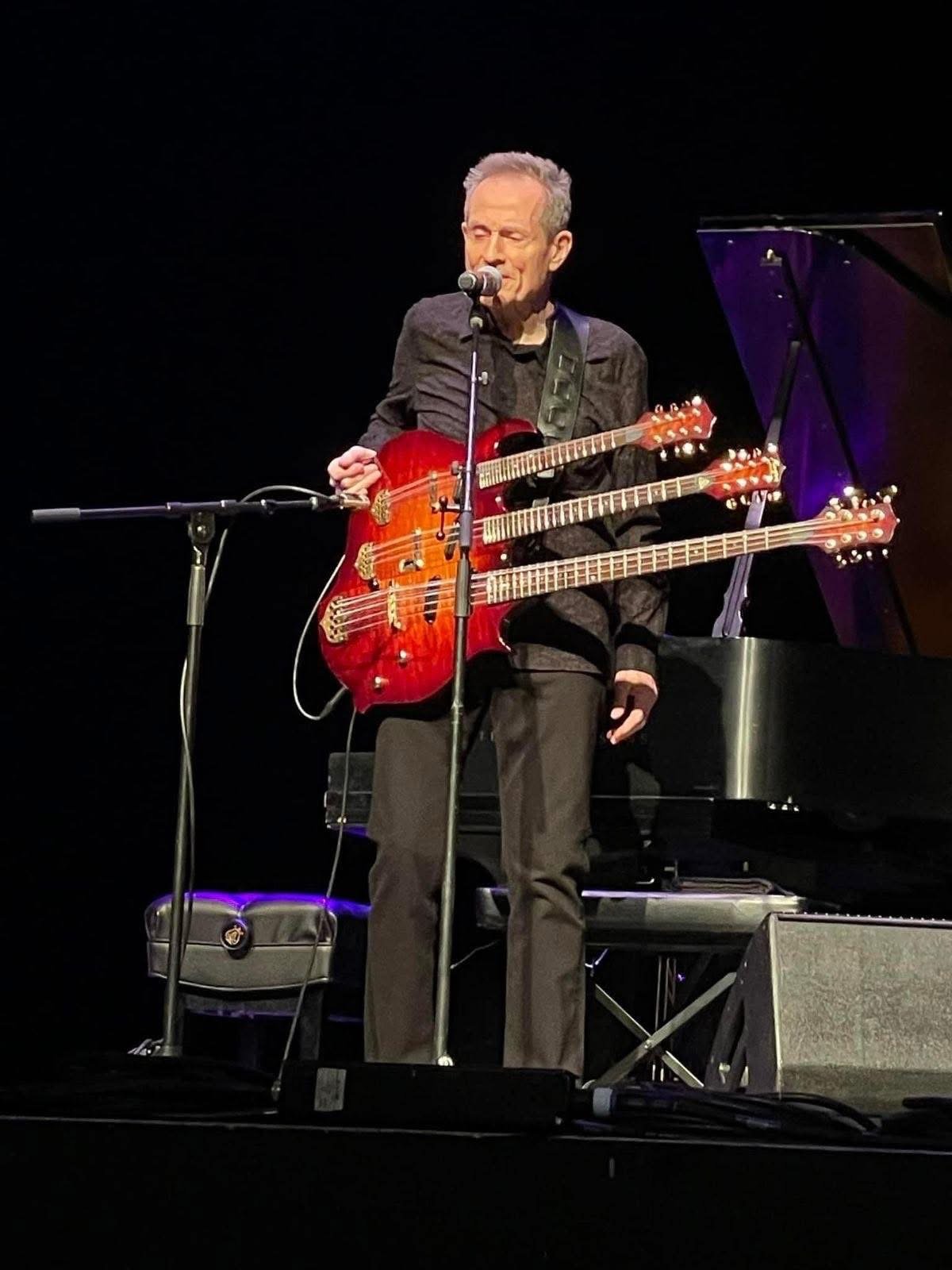
When you imagine legendary multi-instrumentalist John Paul Jones, the foundational low end of Led Zeppelin, you’re conjuring not just a bass player, but a sonic architect. Now picture him with an otherworldly instrument — a three-neck guitar, each neck strung with 8 strings. That’s 24 strings of pure musical potential, in the hands of a man known for pushing musical boundaries. It’s less a guitar and more a declaration: complexity and mastery can live side by side.
The idea of a three-neck, 24-string instrument sounds almost absurd at first — overkill, even. But not in the hands of John Paul Jones. For someone who played organ, bass, mandolin, piano, and countless other instruments with seamless virtuosity, a multi-necked instrument becomes a tool of expression rather than excess. Each neck, presumably tuned differently — perhaps one in standard, one in an open tuning, and one designed for mandocello voicings or drone harmonies — could allow him to switch styles mid-performance. Where most musicians might see chaos, Jones would see possibilities.
John Paul Jones has always defied traditional roles. While Jimmy Page scorched the sky with his riffs and Robert Plant howled mythic tales, Jones was the grounding force and secret weapon, weaving together funk, folk, classical, and Eastern influences. His solo projects and collaborations after Zeppelin showed he was far more than a sideman. In that context, a 24-string behemoth feels like an extension of his ever-curious musical spirit — part instrument, part experimental lab.
Technically, such an instrument would be a challenge to build and play. Each neck would need precise calibration, the string tension balanced carefully to avoid warping the body. The player would require not only dexterity but a mind capable of navigating multiple musical systems at once. Jones, with his conservatory background and encyclopedic knowledge of music theory, fits that profile. He could theoretically use one neck for rich bass lines, another for chime-like chordal work, and a third for melodic passages — all without changing instruments. That means a single performance could become a multi-layered journey through genres and eras, all within the span of a song.
Visually, it would be a spectacle. The three necks stretching like tree limbs from a single core body would immediately evoke curiosity and awe. It’s a stage presence and a musical challenge rolled into one. Jones is known for his unassuming demeanor, often letting the music speak louder than his presence — but an instrument like this would command attention. It might even serve as a metaphor for his career: multidimensional, meticulously crafted, and never quite what you expect.
But beyond the technicality, what truly makes the idea of John Paul Jones with a 24-string, three-neck instrument compelling is the thought of what music would emerge. Would it be a progressive epic with layered textures? A minimalist ambient piece using harmonic drones? A baroque-folk hybrid? With Jones, all are possible. He’s as comfortable improvising in Arabic scales as he is laying down groove-based funk. A complex instrument in his hands doesn’t limit — it liberates.
Ultimately, John Paul Jones wielding a 24-string, three-neck instrument is more than an image — it’s an emblem of innovation. It represents the musician’s eternal hunger to explore, to challenge norms, and to make music that transcends the tools used to create it. Whether on bass, keys, or a surreal Frankenstein guitar, Jones reminds us that instruments don’t make music. Musicians do. But give a master an unusual tool, and he just might change the way we hear the world.