
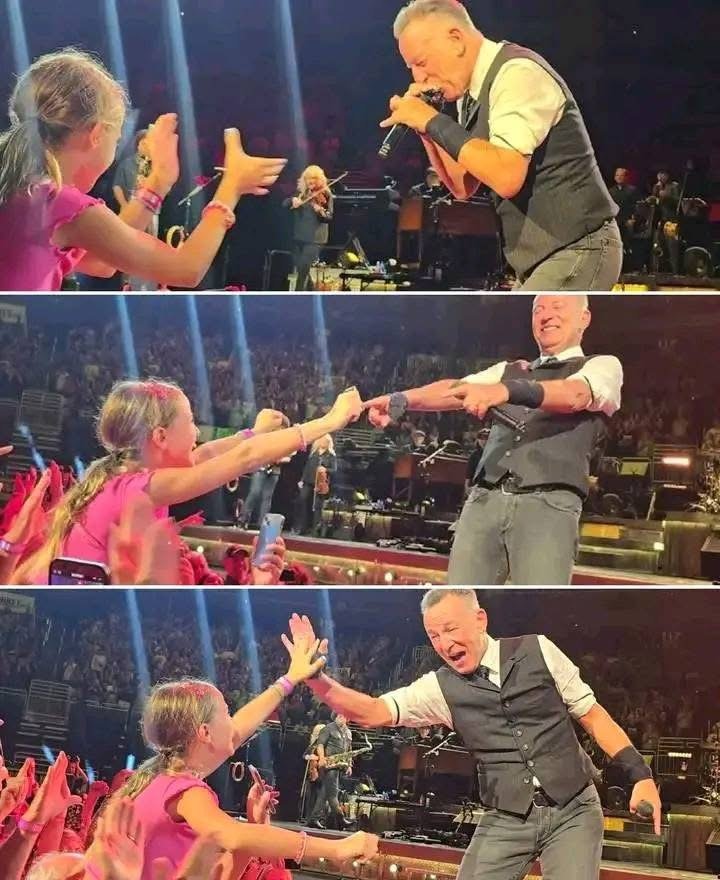
It was a moment so intimate, so unguarded, that time itself seemed to pause. Bruce Springsteen, mid-verse in *“The Promised Land”*, abruptly stepped away from the mic during a sold-out show at MetLife Stadium. For a breathless beat, the band played on. Then, without a word, Springsteen descended from the stage, harmonica still warm from his breath, and approached the front row—eyes locked on a child no more than ten, wearing a weathered *Born to Run* shirt three sizes too big.
The kid stood wide-eyed, gripping the barricade, frozen in disbelief. This wasn’t staged. There were no lights dimmed for effect, no signal to the cameras. It was raw. Spontaneous. Real. Springsteen knelt down, handed over the harmonica like it was a relic, and gently placed his hand on the boy’s shoulder. No words were exchanged. None were needed.
In an era when live music is often filtered through screens and social feeds, the purity of this exchange hit like thunder. The Boss, at 75, wasn’t just performing a song. He was passing something sacred on—emotion, memory, legacy. The harmonica, a small, dented Hohner that had traced countless miles and melodies, suddenly became something else entirely: a baton between generations.
For long-time fans, it was a spiritual callback to Springsteen’s earliest days—when his performances were less concerts and more communal rites of passage. But here, amid an arena of tens of thousands, one boy became the center of it all. The band slowed, sensing the gravity of the gesture. When Springsteen finally returned to the mic, he didn’t speak. He just raised his fist and, with renewed fervor, roared back into the chorus: *“Blow away the dreams that tear you apart…”* The crowd erupted, not just in applause, but in shared emotion. Many wiped tears.
This wasn’t just about a harmonica. It was about belief. In music. In connection. In the next generation. The kid didn’t have to sing a note or strum a chord to understand that something profound had been handed to him. A symbol of resilience, of joy, of rebellion and hope—all the things Springsteen has embodied for over five decades.
Later, fans would flood social media with shaky footage of the moment. A few would claim it reminded them why they fell in love with live music in the first place. Others called it “the spirit of rock ‘n’ roll, crystallized.” But perhaps the most powerful testimony came from those who said nothing at all—just a photo of the boy holding the harmonica, overwhelmed, eyes glassy, next to his equally stunned father.
Springsteen has long said that his shows are a conversation, not a performance. On this night, he spoke volumes without saying a word. In that hushed, soul-stirring exchange with a boy too young to remember *Born in the U.S.A.*’s heyday, he redefined the stakes of the live experience. It wasn’t about the lights or the setlist. It was about legacy—and the invisible threads that tie us together across time, age, and sound.
And so, in a moment that stopped the show, Springsteen didn’t just give away a harmonica. He gave away history, heart, and a piece of himself—ensuring that the promise of *The Promised Land* would continue to echo in new ears for years to come.