
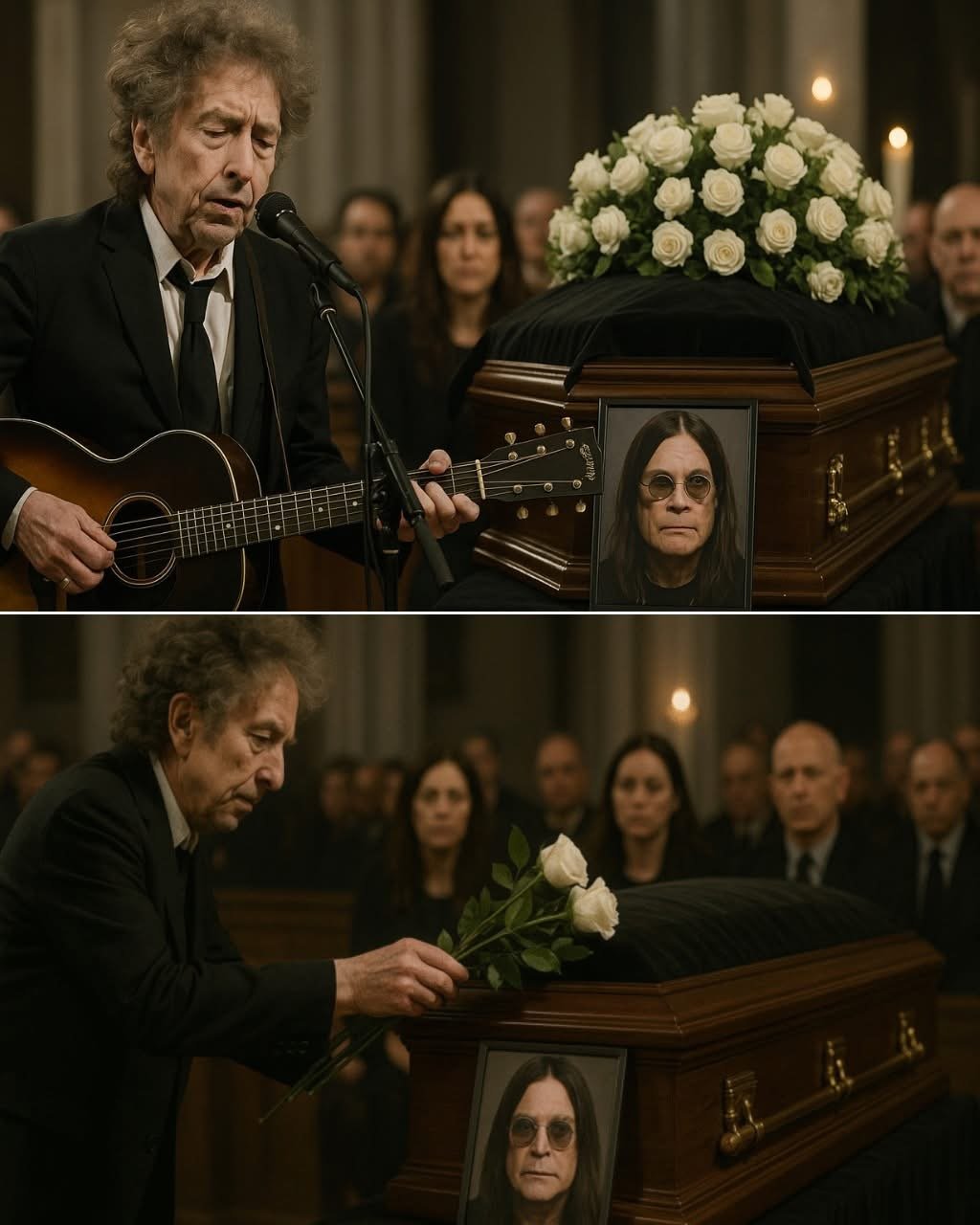
Not the kind born of reverence or ritual, but the hush that descends when words become useless, when music must speak where language fails. Every pew was filled, yet the room felt hollow, as if the soul that once danced in wild rebellion had taken the light with it. The stained-glass windows flickered faintly under a gray sky, casting muted colors onto the mahogany casket that rested at the altar. A lone microphone stood waiting at the podium, solemn as a headstone.
Then, slowly, from the back of the chapel, Bob Dylan emerged.
He looked smaller than most remembered — age and time having chiseled him down to something wiry and weathered. His boots made soft, deliberate thuds on the stone floor. In his hand, he carried his old guitar, the same battered companion that had followed him across highways, through protest marches and dive bars, into stadiums and smoky studios. It wasn’t just an instrument; it was a relic of a generation, and on this day, it was an offering.
There were no stage lights. No swelling orchestra. No roar of the crowd. Just Dylan.
He approached the microphone without a word, nodded slightly to the gathered mourners — a constellation of rock legends, poets, outlaws, and fans too grief-stricken to speak. Dylan didn’t need an introduction. His presence alone shifted the weight in the room. He sat down on the worn wooden stool placed before the podium, adjusted the strap on his shoulder, and bowed his head.
For a moment, he stayed there, still and silent, as though communing with a spirit only he could see. Maybe he was remembering the first time he and Ozzy had crossed paths — backstage at some chaotic festival in the early ’70s, both of them riding waves of noise, smoke, and youth. They had been two outlaws from different camps, yet kindred in their refusal to bow to anything but the truth of their music.
He looked up and began to play.
The first chord was tentative, almost fragile, like a memory surfacing after years of being buried. Then came the voice — unmistakable, timeworn, cracked around the edges, but burning with something untouched by age. Dylan didn’t sing to impress. He never had. He sang to survive, to testify, and today he sang to mourn. The lyrics, penned just for this moment, carried the ache of loss and the fire of a brotherhood forged in the heat of rebellion.
His words spoke of hotel rooms lit by candle smoke, of backstage laughter and bloodshot dawns, of chaos turned into communion under the weight of a riff or the sting of a lyric. He sang of Ozzy’s chaos — beautiful and uncontainable — and the quiet moments few ever saw: the kind glance, the deep questions, the vulnerable heart beneath the spectacle. He sang of love disguised as noise, of friendship written not in hugs or photographs, but in a shared, defiant howl at the world.
By the time the final chord faded, there wasn’t a dry eye in the chapel.
Dylan stood slowly, walked the few steps toward the casket, and placed his weathered hand gently on the polished wood. For a long moment, he said nothing. Then he leaned forward and whispered just loud enough for the front row to hear:
“Rest easy, brother.”
And then he walked away.
No encores. No explanations. Just a man who had lost a friend, saying goodbye in the only language that ever truly mattered to either of them.
In the silence that followed, even the stained glass seemed to dim in mourning.
—
Let me know if you’d like to tailor this further — for a screenplay, eulogy, or memorial article.