
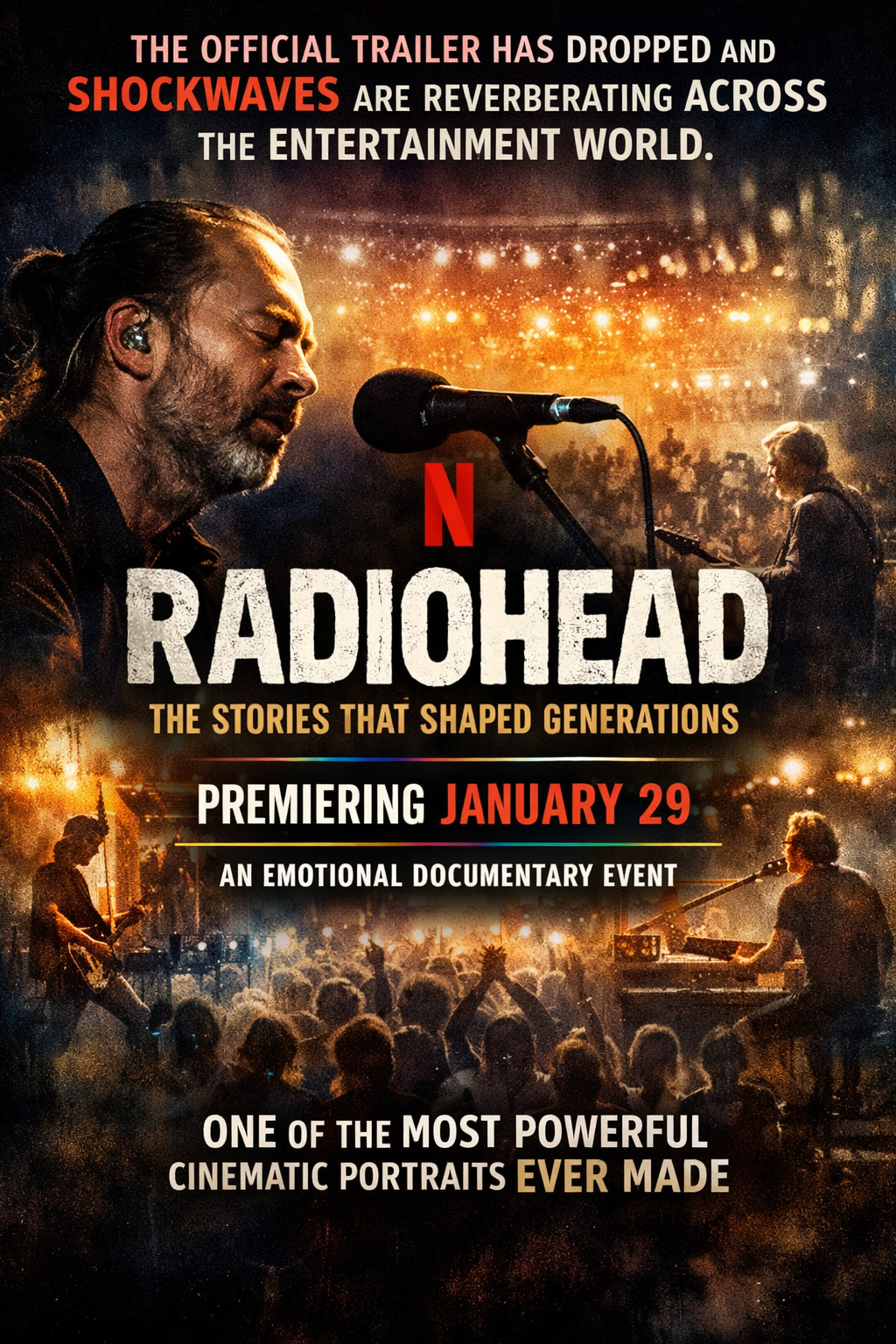
Netflix has just dropped the official trailer for “RADIOHEAD: The Stories That Shaped Generations,” and within minutes, it sent shockwaves across the entertainment world. Slated to premiere on January 29, this documentary is already being whispered about as one of the most emotionally powerful cinematic portraits ever released.
Netflix has officially unveiled the trailer for “RADIOHEAD: The Stories That Shaped Generations,” and almost instantly, the internet seemed to hold its breath. Within minutes of the trailer’s release, social feeds flooded with stunned reactions, music forums lit up with emotional retrospectives, and longtime fans began counting the days. Set to premiere on January 29, the documentary is already being hailed as a landmark cultural moment—one that goes far beyond a standard music biography.
At its core, The Stories That Shaped Generations is not just about Radiohead as a band, but about Radiohead as a feeling—an emotional language spoken across decades. The trailer opens with sparse piano notes layered beneath archival footage of the band’s early days, immediately signaling that this film will be intimate, reflective, and unafraid of vulnerability. Rather than racing through chart positions and accolades, the documentary appears to linger in the quiet spaces where meaning is formed.
From the outset, the film positions Radiohead as accidental prophets of modern anxiety. Through rare interviews, studio recordings, and unseen behind-the-scenes moments, the documentary traces how the band’s music became a mirror for societal unease—technology’s rise, political disillusionment, climate dread, and the quiet loneliness of an increasingly connected world. The trailer’s narration hints at this theme with a simple but devastating line: “They weren’t predicting the future. They were listening to it.”
One of the most striking elements teased in the trailer is the documentary’s emotional honesty. Frontman Thom Yorke appears in several raw interview clips, speaking candidly about creative paralysis, the weight of expectation, and the fear of becoming irrelevant in a world that consumes art at breakneck speed. These moments are intercut with footage of sold-out stadiums and euphoric crowds, creating a powerful contrast between public adoration and private doubt.
The film also gives long-overdue space to the other members of the band—Jonny Greenwood, Ed O’Brien, Colin Greenwood, and Philip Selway—each reflecting on their individual roles within Radiohead’s constantly evolving identity. The documentary suggests that Radiohead’s longevity is rooted not in perfection, but in tension: creative disagreements, artistic risks, and the refusal to remain comfortable. For fans, this behind-the-curtain access feels less like celebrity exposure and more like an invitation into a shared history.
Visually, the documentary promises to be as experimental as the band itself. The trailer showcases a blend of analog grain, glitch aesthetics, abstract animation, and haunting performance footage. It feels deliberately disorienting at times—an artistic choice that mirrors Radiohead’s sonic experimentation. This is not a polished nostalgia piece; it’s a living, breathing collage of memory, sound, and emotion.
Perhaps most compelling is the way the documentary frames Radiohead’s impact across generations. The trailer features brief appearances from musicians, producers, and fans whose lives were shaped by albums like OK Computer, Kid A, and In Rainbows. These testimonials don’t feel scripted or reverent; they feel personal. Stories of heartbreak, survival, protest, and self-discovery unfold, reinforcing the idea that Radiohead’s music didn’t just soundtrack lives—it helped define them.
Early reactions to the trailer suggest that The Stories That Shaped Generations may transcend fandom altogether. Even viewers who don’t consider themselves Radiohead devotees are expressing curiosity, drawn in by the documentary’s emotional weight and universal themes. In an era oversaturated with music documentaries, this one feels different—less about legacy-building and more about honest reckoning.
As January 29 approaches, expectations are undeniably high. Yet if the trailer is any indication, Netflix may have delivered something rare: a documentary that understands music not as entertainment, but as a shared emotional archive. RADIOHEAD: The Stories That Shaped Generations looks poised to remind audiences why art matters—especially when it dares to tell the truth.
For many, this won’t just be a film. It will be a reckoning, a reunion, and a quiet, cathartic reminder that some music doesn’t age—it evolves alongside us.